Assessments and the collection of data are vital for any educator in order to continue to have a real impact on the learning of the students in their care.
The challenge that is being faced by all educators is the amount of data, the type of data and use of that data. However, let's focus on one data collection point at this time.
With many innovative or revamped pedagogies and programs; genius hour, maker space, innovation time, computer programming, mystery locations, breakoutEDU, How do we as educators assess what are students are learning? Do have to? To what end? How much detail? How do we report it? Where do they fit into our current report structure?
Many educators see all of these learning events as being vital for the students in their classrooms. They fit into the learning in every way and those who are utilising these in their classes can see their value. However, there are still the education structures that we must fit into. We want to change the education landscape, but like many things, this takes time. How do we do what we know needs to be done for the interest of the learners in our classes and still fulfil our requirements?
The online blogs and digital portfolios (Seesaw is the current one I am using) are fantastic ways to share the learning. These allow educators to share work samples, video, picture and students reflections directly with the parents and investors. When reports come along, where are people putting all the amazing learning?
Last year I put all this great data into the general comments and for some students into Science or English. Where does this fit in a busy school report schedule? How can others see the progress in the written report/assessment structure?
Showing posts with label Education. Show all posts
Monday, 18 April 2016
Monday, 14 December 2015
BreakoutEDUau Launch at Google Sydney
You are stuck in a room with a number of like minded people. You are told that you have been set a challenge - open this box - there are 5 locks on it. Your instructions are:
"There are clues around this room that link to the locks that are on this box. You have 45 minutes and whatever resources you have on you to solve the puzzles to open the box. GO!"
Welcome to BreakoutEDUau.
This week I had the fantastic opportunity to experience the BreakoutEDUau launch at Google Headquarters in Sydney.
I was part of the second launch group with trail blazing Australian Educators showing us the way; Kim Sutton, Chris Betcha and Nick Brierley. I have to say that there is no better way to launch an idea with educators than to get us to participate. Playing this game allowed me to see what this could look like in my classroom or even as a staff training exercise to get us thinking the way we want our students thinking.
This game was focused around the history of communication. The clues included invisible ink, images, codes, hieroglyphs, riddles, knotted strings, QR codes, websites and email addresses. There was so much opportunity to think laterally, work collaboratively and look at a couple of problems in a number of ways. It required persistence, group work, mathematics, history, use of technology and drawing on past knowledge.
This concept was launched in the USA earlier in the year by James Sanders- founder of @BreakoutEdu. On his website James states that:
"Breakout EDU creates ultra-engaging learning games for people of all ages. Games (Breakouts) teach teamwork, problem solving, critical thinking, and troubleshooting by presenting participants with challenges that ignite their natural drive to problem-solve."
From what I experienced this week BreakoutEDUau stays true to the experience that the founder had in mind. This educational concept was born from James Sanders playing the games in "Breakout Rooms" and from there he prototyped and developed the breakout box. If you are like me and like to meet the developer, James Sanders, and hear him explain the game and process of development then watch this interview.
The great part of this game is that you can use it as you buy it or you can make it totally your own. The BreakoutEDU community is growing and organically sharing ideas and clues, as well as whole games. This community will continue to grow as more educators get on board.
If you are looking for something new to truly incorporate the 21st Century Skills and those soft skills that our students will need in the real world then take a look at -
"There are clues around this room that link to the locks that are on this box. You have 45 minutes and whatever resources you have on you to solve the puzzles to open the box. GO!"
Weather was a little intense here.. 35C (95F) at 6pm. We'll cool it down at the next event! #BreakoutEDU #edchat pic.twitter.com/AkgRMZ59bv
— Breakout EDUau (@breakoutEDUau) December 11, 2015
Welcome to BreakoutEDUau.
This week I had the fantastic opportunity to experience the BreakoutEDUau launch at Google Headquarters in Sydney.
I was part of the second launch group with trail blazing Australian Educators showing us the way; Kim Sutton, Chris Betcha and Nick Brierley. I have to say that there is no better way to launch an idea with educators than to get us to participate. Playing this game allowed me to see what this could look like in my classroom or even as a staff training exercise to get us thinking the way we want our students thinking.
This game was focused around the history of communication. The clues included invisible ink, images, codes, hieroglyphs, riddles, knotted strings, QR codes, websites and email addresses. There was so much opportunity to think laterally, work collaboratively and look at a couple of problems in a number of ways. It required persistence, group work, mathematics, history, use of technology and drawing on past knowledge.
This concept was launched in the USA earlier in the year by James Sanders- founder of @BreakoutEdu. On his website James states that:
![]() |
| Photo by @kehall16 |
From what I experienced this week BreakoutEDUau stays true to the experience that the founder had in mind. This educational concept was born from James Sanders playing the games in "Breakout Rooms" and from there he prototyped and developed the breakout box. If you are like me and like to meet the developer, James Sanders, and hear him explain the game and process of development then watch this interview.
The great part of this game is that you can use it as you buy it or you can make it totally your own. The BreakoutEDU community is growing and organically sharing ideas and clues, as well as whole games. This community will continue to grow as more educators get on board.
Remember that it should always be about the thinking and learning!
This is perfect!
If you are looking for something new to truly incorporate the 21st Century Skills and those soft skills that our students will need in the real world then take a look at -
BreakoutEDUau
Thursday, 22 October 2015
Another Fantastic Example of Genius Hour!
Just wanted to share another amazing example of how Genius Hour has impacted my classroom.
Here is Christos presenting his genius and research about democracy. He is 10 years old and has a respect for government because of his research than many adults.
Tuesday, 20 October 2015
Genius Hour's - Educational Value
It has been a few months since my last post but so much has been happening. Genius Hour has continued to be a force in my classroom each week and there have been some significant development in my students over that time.
I want to share with you two of standout moments recently.
One of my student's put the forward "Dyslexia from a kids perspective." as his task. He did lots of reading and questioning. He also spoke to an expert. The following video was how he decided he wanted to share his learning from the experience. This is a must watch! He was keen to connect it to Dyslexia Empowerment Week. He has taught me so much over the past term.
I want to share with you two of standout moments recently.
One of my student's put the forward "Dyslexia from a kids perspective." as his task. He did lots of reading and questioning. He also spoke to an expert. The following video was how he decided he wanted to share his learning from the experience. This is a must watch! He was keen to connect it to Dyslexia Empowerment Week. He has taught me so much over the past term.
Another student wanted to look into "How to develop a good soccer player." He did much of his research at home and the product of the research was a website. The web design become a large part of the learning process and he decided to launch it and continue its development. The components that make up a good soccer player are there but how to develop this is still coming. It has been a great journey so far.
Saturday, 18 July 2015
It's all about the Student Engagement!
It is all about the student engagement! This is what my week has been about. As we all know there are so many things that happen in the week of the educator, but this week was like I entered into a theme park on Monday and left on Friday.
This theme park had so many attractions that could be focused on but I am keen to share about the killer roller coaster of student engagement.
I was prepared and excited to be coming back from mid-year break. I was ready to introduce the new topics for the term, however, I was most excited about introducing Genius Hour to my Year 4 class.
My stage also had planned an immersion activity for our PBL unit: Was life the same for everyone? (colonisation). My stage then had an innovation planning day on the Friday with a science focus to allow us, as Jr School teachers, spend time with our HS head of science, promoting investigations from a true scientific direction.
I felt that my week was going to be excellent. I could not have been more correct.
Student rapport and engagement have always been central to my teaching. Always on the look out, as many of you are, for something to grab the students and make them see themselves as you see them. Genius Hour has grabbed me this year. While this concept, from research appears to be gaining legs in the US, here in Australia there are only some small pockets of educators talking about it.
When I introduced GH to the class this week I was blown away by their excitement and enthusiasm. Feel free to track how GH is going in my class through the "Idea Share" section on my blog. I am going to post there about all the trials and tribulations that occur along the way. There was one reaction that literally made me leap in the classroom as I heard it.
Framing the moment - I have finally explained to my class what GH is. There had been one small poster on our board and the students had been asking for two days what it was about. I followed the lead of those before me (Chris Kesler) and prepared as suggested with multimedia presentations, I even used the 'Kid President" video, which was a hit. The students have learned the 3 Rules that GH will run with and they are going somewhere in the classroom to brainstorm ideas. One student (JW) jumps up, a few moments later than everyone else, who have run off to get their ideas down before they fall out of their heads. JW runs to me and says excitedly, in a strong and proud voice:
"Mr Hosking, I am going to tell the world about dyslexia from a kids perspective!"
If that is not engagement, I don't know what is. I cannot wait to see what comes from that first thought, but JW has the Genius Hour bug as the next day his mum came up and said that he was "bouncing off the walls excited to learn" when he got home.
As I said, student engagement was a roller coaster this week.
The whole of Stage 2 were buzzing, it was sport day but their teachers were dressed up in 'weird' clothing from the start of the day. We were in character, the everyday British people of the 1770s. What the students learnt was that we were actually people from the first fleet to Australia. Today was our trial and the four classes were directed by guards, also dressed up, into the 'courtroom' ready for the judgement. The trial started and we were sentenced.
Student engagement was high. So high, that it all felt too real for some of the students. After some debriefing all was fine. However, while it was fun and I would do it again in a heart beat, the spotlight was thrown onto the idea of failure. I could see this as a failure, or as a set back to what was trying to be achieved. I choose not to. I see this as win! Next time I will take into account and be better prepared for this as a possibility in student reaction. However, it was great and the students are asking questions and looking for answers as to why people were treated this way and why the need for transportation.
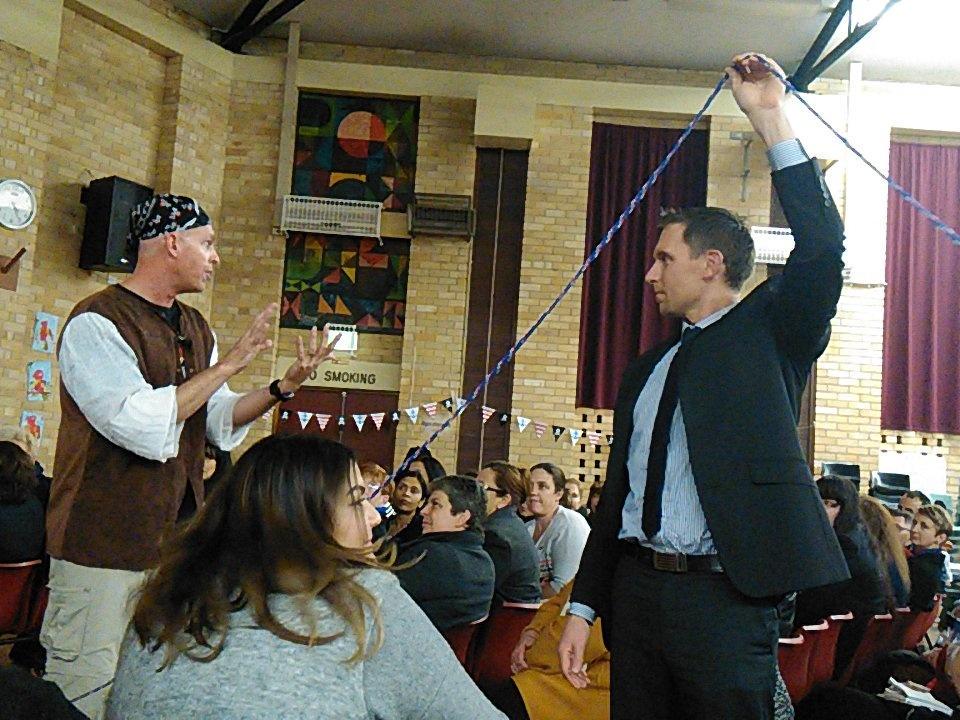
A good roller coaster ends with you wanting to have that thrill back. Teach Like a Pirate was that end. Thanks to the enthusiasm, and experience of Dave Burgess, I am highly motivated to keep the thrill of this week a reality in my classes permanently. At the beginning of the week I had only heard of the book Teach Like a Pirate but had not read it and not really looked into the idea. I was invited to tag along with a colleague to a PD evening with the Pirate himself, Dave Burgess.
I have to say that I am 'hooked'. Dave Burgess was motivating and entertaining. His enthusiasm for the students in his class is unmatched. Working with some of the hardest students in his district he has planted the love of learning in their lives.
Some of the key take homes for me include:
These images are available on Dave Burgess's site.

This theme park had so many attractions that could be focused on but I am keen to share about the killer roller coaster of student engagement.
I was prepared and excited to be coming back from mid-year break. I was ready to introduce the new topics for the term, however, I was most excited about introducing Genius Hour to my Year 4 class.
My stage also had planned an immersion activity for our PBL unit: Was life the same for everyone? (colonisation). My stage then had an innovation planning day on the Friday with a science focus to allow us, as Jr School teachers, spend time with our HS head of science, promoting investigations from a true scientific direction.
I felt that my week was going to be excellent. I could not have been more correct.
Student rapport and engagement have always been central to my teaching. Always on the look out, as many of you are, for something to grab the students and make them see themselves as you see them. Genius Hour has grabbed me this year. While this concept, from research appears to be gaining legs in the US, here in Australia there are only some small pockets of educators talking about it.When I introduced GH to the class this week I was blown away by their excitement and enthusiasm. Feel free to track how GH is going in my class through the "Idea Share" section on my blog. I am going to post there about all the trials and tribulations that occur along the way. There was one reaction that literally made me leap in the classroom as I heard it.
Framing the moment - I have finally explained to my class what GH is. There had been one small poster on our board and the students had been asking for two days what it was about. I followed the lead of those before me (Chris Kesler) and prepared as suggested with multimedia presentations, I even used the 'Kid President" video, which was a hit. The students have learned the 3 Rules that GH will run with and they are going somewhere in the classroom to brainstorm ideas. One student (JW) jumps up, a few moments later than everyone else, who have run off to get their ideas down before they fall out of their heads. JW runs to me and says excitedly, in a strong and proud voice:
"Mr Hosking, I am going to tell the world about dyslexia from a kids perspective!"
If that is not engagement, I don't know what is. I cannot wait to see what comes from that first thought, but JW has the Genius Hour bug as the next day his mum came up and said that he was "bouncing off the walls excited to learn" when he got home.
As I said, student engagement was a roller coaster this week.
Student engagement was high. So high, that it all felt too real for some of the students. After some debriefing all was fine. However, while it was fun and I would do it again in a heart beat, the spotlight was thrown onto the idea of failure. I could see this as a failure, or as a set back to what was trying to be achieved. I choose not to. I see this as win! Next time I will take into account and be better prepared for this as a possibility in student reaction. However, it was great and the students are asking questions and looking for answers as to why people were treated this way and why the need for transportation.
![]() |
| Image from @HostBrian |
I have to say that I am 'hooked'. Dave Burgess was motivating and entertaining. His enthusiasm for the students in his class is unmatched. Working with some of the hardest students in his district he has planted the love of learning in their lives.
Some of the key take homes for me include:
- Teaching is not supposed to be easy. It is supposed to be WORTH it!
- It is not enough to be good, you have to inspiring.
- If you had to sell tickets to your classes, would anyone be there?
- Use hooks to engage the students and then deliver content at their peak engagement.
These are questions that I look forward to asking myself more regularly. What are some of the questions that you ask yourself to gauge if you are on the right track?
Walking away from the most entertaining and motivating PD sessions for some time, with a new book to read and a head full of possibilities, I could not help but smile. I am looking forward to the next ride on this roller coaster.
These images are available on Dave Burgess's site.

Sunday, 12 July 2015
Learning Design Professional Development
Over the past week I
have had the opportunity to participate in professional development (PD) using
the Backward Design model, suggested by Wiggins and McTighe, focusing on our Learner Profile. It was a great
privilege to have Simon Breakspear lead the staff through this process. His
expertise in considering educational reform and learning innovation was
refreshing.
Simon
made it clear that as educators we are; constantly working towards specific
learning goals, considering all aspects of learning, planning exciting and
engaging learning experiences. He reinforced the concept that innovation comes
as true shifts in ideas change. We were encouraged to make small changes, but
big leaps in thinking. Simon also made it clear that when we want to innovate
we must make it about the quality of
learning and not about the new technology.
The
shifts made this year in my thinking; about education and where I, or the
‘teacher’, fits into the educational landscape was again brought to the floor
as Simon set the task for the following sessions, stating that educators should
consider themselves as ‘learning designers’.
So
as ‘Learning Designers’ we set to work on our driving question; “How do
we design, implement and evaluate an educational experience that shapes the
school’s Learner Profile (LP) in our students?” using the Wiggins and McTighe three stage
model:
It
was amazing to have time carved out of our busy schedules to sit and consider key outcomes
the staff have identified for our students to have when they leave school.
In
mixed discipline groups, primary and high school, we came up with ‘non-jargon’
definitions of the two outcomes we were focusing on this year. From here we decided
what was acceptable evidence to prove that these outcomes were being achieved.
This allowed us to created a rubric that showed a clear continuum of learning.
Seeing
the definitions, reasons for their importance and the rubrics created by each
of the 19 groups, through a shared Google Doc in real time, was exciting. This
created a crowd sourced resource, spanning Kindergarten to Year 12, that can
begin to allow us to track the progress of a student over time. It allows for
authentic and purposeful assessment, providing a basis for growth, as the
student can see what they are achieving and the next step to take in order to
improve.
Most
importantly, doing this allowed the staff, as a whole, to reflect on what the
LP means and how it relates to their field of expertise.
At
this point we began to apply the process in our own teams with a learning
experience that we could teach this coming term. Being given the green light to
go and trial our PD learning was great but challenging.
I
would encourage other educators to give yourself or your team to go into the
“Pit of Learning”. It will be hard, there will be debates and challenges to
face but that is because you are passionate.
As
we all look forward to a new term of learning, I also encourage you to consider
one area that you can have a go of applying or reapplying the ‘Backwards by
Design’ concept.
Have
fun!
My
key take away - when we want to innovate we must make it about the quality of learning and not about the new
technology.
Follow Simon Breakspear - @SimonBreakspear
Subscribe to:
Posts (Atom)


